0:00London, 2026
London, April 2026. A finish clock nobody has ever seen in a real race. One hour, 59 minutes.
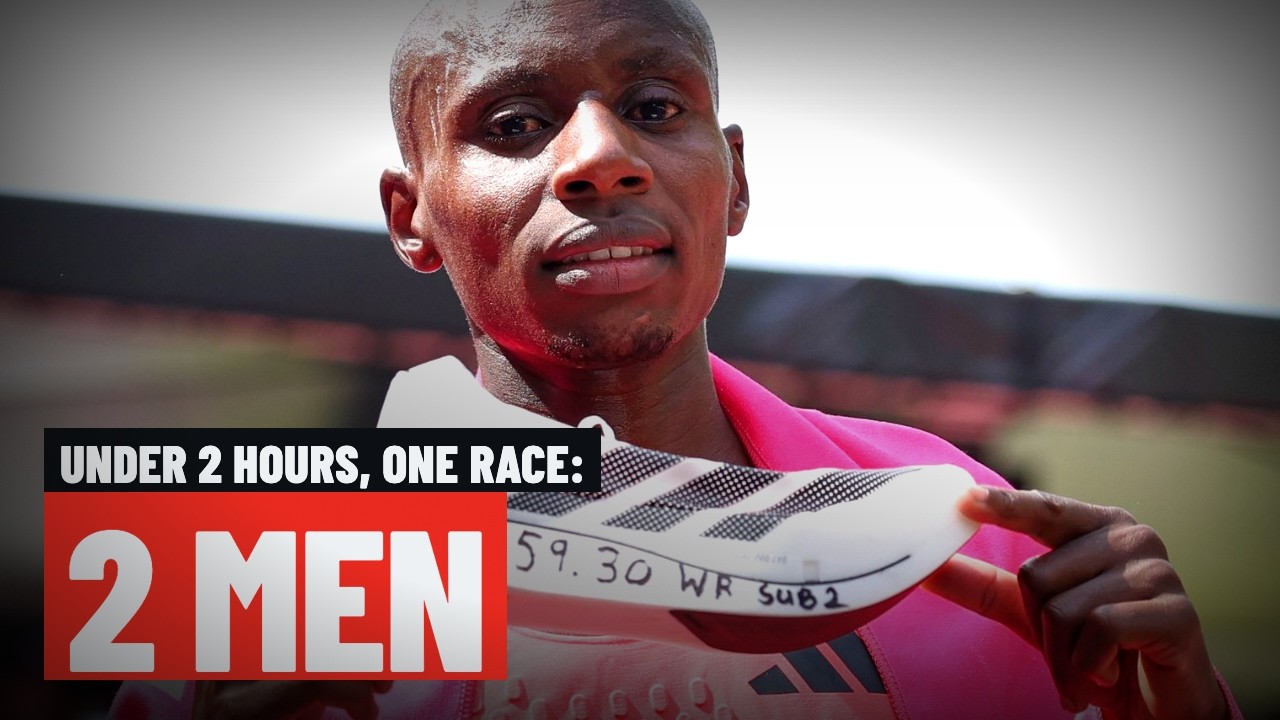
Sabastian Sawe crosses the line in 1:59:30. COMMENTATOR: …and he has smashed it! Wow.
Eleven seconds later, a second man comes in. Also under two hours. For more than a century, no one had run a marathon under two hours in a race that counted.
That morning, two men did it, in the same race. And it happened in the same city where the marathon, as we know it, was born. So what changed?
Why did a wall that stood for 118 years fall in one morning? The first marathons weren't all the same length.
0:44London, 1908
That changed at the London Olympics in 1908. The race started at Windsor Castle and finished in front of the royal box in the stadium. 42 kilometres and 195 metres.
That odd distance became the marathon. The first man into the stadium was an Italian, Dorando Pietri. He took a wrong turn, and he fell.
Then he fell again, several times. Officials held him up and helped him to the line. He finished first, but after a protest, he was disqualified for getting help.
The gold went to the American, Johnny Hayes. Two hours, 55 minutes. The first official marathon world record.
From there, the record came down fast.
1:28The long slope
In Rome in 1960, an Ethiopian soldier named Abebe Bikila won the Olympic marathon barefoot. His shoes had worn out, and the new ones gave him blisters. He still ran faster than anyone ever had, two hours fifteen.
In 1967, an Australian, Derek Clayton, became the first man under two hours ten. And then it got hard. For forty years, the record came down in small steps.
In 2008, the great Haile Gebrselassie ran two hours, three minutes and 59 seconds. Two hours was still four minutes away. Back in 1991, a scientist named Michael Joyner calculated what a perfect runner could do.
His answer was about 1:58, a number on paper. For decades, nobody came close. Then came Eliud Kipchoge.
2:19The run that didn't count
In 2017, Nike set up a test on a motor-racing track in Italy. Kipchoge missed two hours by 25 seconds. Two years later, in Vienna, they tried again.
41 pacemakers ran with him in teams, swapping in and out. A car showed the pace. Cyclists brought him his drinks.
1:59:40, the first human to run that distance in under two hours. COMMENTATOR: And you know, Kipchoge was right. “No human is limited.”
But it wasn't a race, and it wasn't a world record. In a real race, the pacemakers start with everyone else and can't swap in fresh. Drinks come from the tables, not from bikes.
In real races, Kipchoge got the record down to 2:01:09. Fast, but still more than a minute too slow.
3:11Kelvin Kiptum
In Chicago in 2023, a 23-year-old Kenyan, Kelvin Kiptum, ran only his third marathon, two hours, zero minutes, 35 seconds. 35 seconds from the barrier. CROWD: Oh my goodness!
Oh my goodness! In February 2024, his record was made official. Days later, he and his coach were killed in a car crash in Kenya.
He was 24.
3:38London, 2026
April 2026, London again. The pacemakers took the leaders through halfway in 60 minutes 29, exactly on schedule for two hours. After 25 kilometres, the last pacemaker stepped off.
And Sabastian Sawe did what nobody expected. He sped up. Only Ethiopia's Yomif Kejelcha could stay with him.
It was his first marathon ever. From 30 to 40 kilometres, Sawe ran faster and faster. In the last few kilometres, Kejelcha couldn't hold on.
COMMENTATOR: This is out of this world from Sabastian Sawe. And he's kicking, and he's kicking again. 1:59:30.
COMMENTATOR: I just can't believe what we're witnessing. Sawe ran the second half in 59 minutes and one second. Kejelcha finished 11 seconds later, the fastest marathon debut in history.
And in third, Uganda's Jacob Kiplimo ran two hours and 28 seconds. Three men in one race, all under the old world record. And this one counted.
SAWE: I didn't believe, but I was well prepared. So what changed? First, the shoes.
4:56Why now
In 2016, Nike put a carbon plate inside a thick, springy foam. Soon, every brand had its own version. In 2020, the sport drew a line: a sole no thicker than 40 millimetres, and only one plate.
Sawe's shoe weighed 97 grams. Its sole was 39 millimetres, one millimetre inside the rules. Second, the race itself.
Everything that day was set up for a fast time. Pacemakers blocked the wind until 25 kilometres. The start was cool, about 10 degrees.
All that was left was the last 17 kilometres. Third, and most important: what Sawe did with them. The plan only took him to two hours.
When the pacemakers left, he didn't hold on. He got faster. The second half took him 59 minutes and one second.
That is where the two hours were broken. Here's what 1:59:30 actually means. Take a running track.
Run one lap in 68 seconds. Now do it more than 105 times, without stopping. That's the marathon now.
And the perfect runner from 1991? 1:58, 90 seconds away. So will someone run 1:58 in your lifetime?