0:00Mexico City, 1968
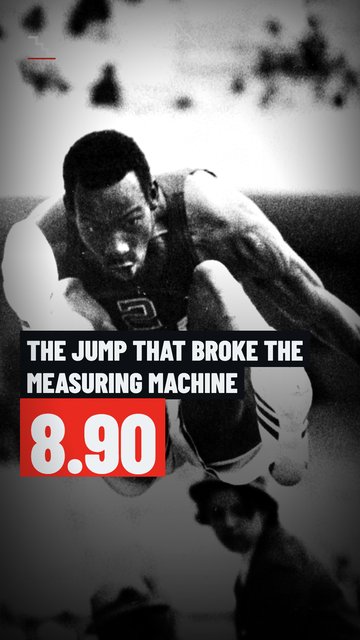
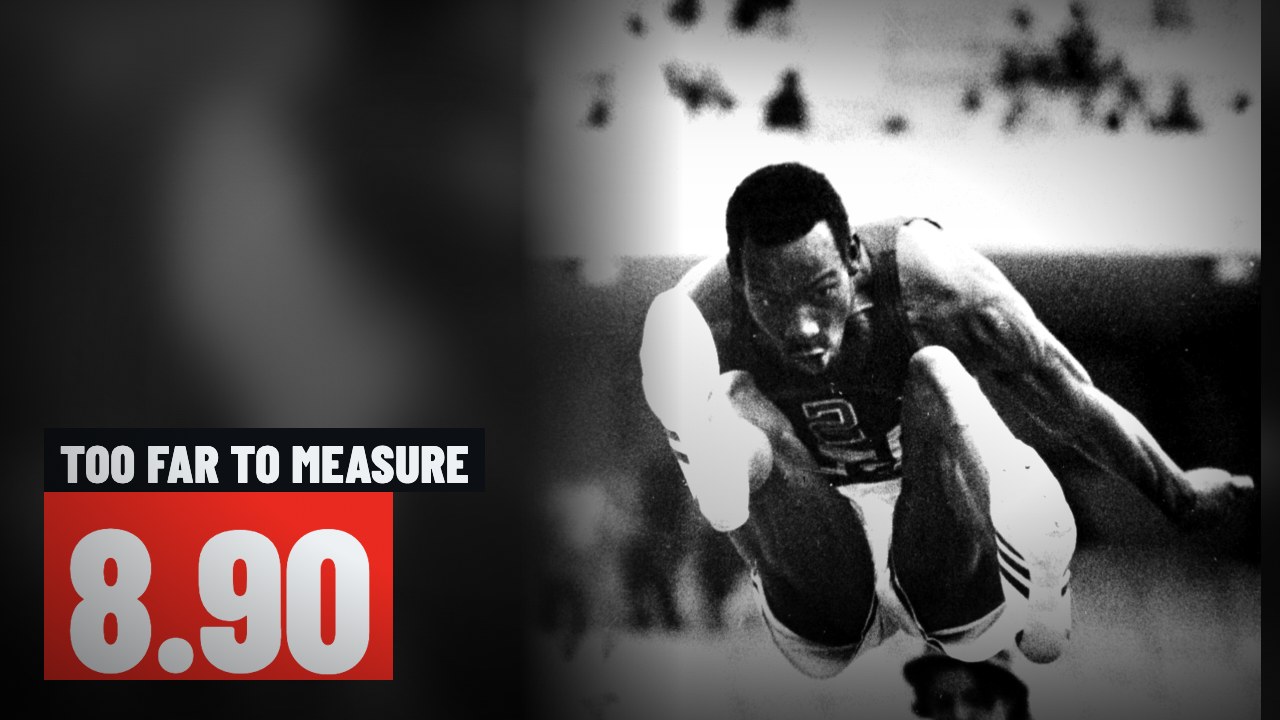
18 October 1968, Mexico City. The fourth man to jump in the Olympic final runs 19 strides, hits the board, and lands so far down the pit that the machine built to measure him runs out of rail. The officials go and find a steel tape.
The number they come back with is 8.90 metres. The world record had been 8.35. One jump just added 55 centimetres to it.
For the next 23 years, nobody on earth jumped that far.
0:35The line before it
To see how strange that is, look at the line before it. The long jump record starts with Peter O'Connor in Dublin, 1901, 7.61. For 66 years it creeps forward, a few centimetres here, a few there.
Jesse Owens jumps 8.13 in 1935, and that number stands for 25 years. Ralph Boston and Igor Ter-Ovanesyan spend the 1960s trading the record back and forth, one, two, three centimetres at a time. By 1967, it sits at 8.35, shared between them.
A typical new record moves the line by about 6 centimetres. Beamon moved it by 55. On the graph, it doesn't look like a step, it looks like a mistake.
1:22The same morning
That same morning, Beamon almost went home. He had arrived as the favourite. Twenty-two years old, he had won twenty-two of his twenty-three competitions that year.
His best legal jump was 8.33, two centimetres short of the world record. In qualifying, he needed 7.65 metres. His first jump was a foul, so was his second.
One attempt left, and the favourite for gold was a single overstep from being out. He measured his run-up again and took off short of the board, giving away distance just to make sure it counted. 8.19, he was through.
The final was that afternoon. Waiting for him were Ralph Boston, the 1960 champion, Lynn Davies, the 1964 champion, and Igor Ter-Ovanesyan, the Soviet co-holder of the world record. People expected a close fight for gold, somewhere around 8.30.
2:16The jump
Final, first round. Three men jump before him. All three foul.
Then Beamon. Nineteen strides. He hits the board.
He rises about six feet into the air, more than 1.8 metres at the top of the flight, and he is still travelling when he passes the eight-metre marks along the pit. He lands near the far end of the sand and bounds out of it. The optical measuring device slides along its rail and stops.
It cannot reach the mark. It was never designed for a jump this long. So the officials do what officials did in 1901.
They stretch out a steel tape.
2:54"Nearly two feet"
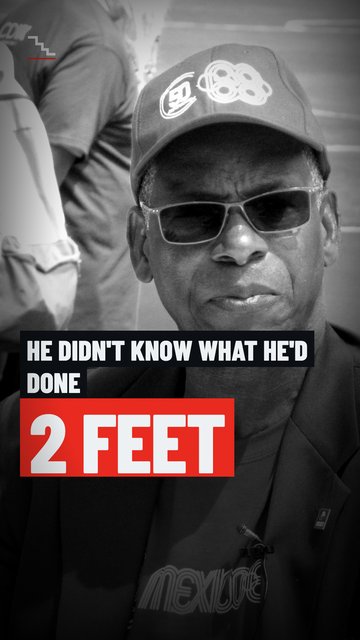
The scoreboard shows 8.90. Beamon doesn't react. He grew up with feet and inches, and the number means nothing to him.
Then Ralph Boston tells him what it means. He has broken the world record by nearly two feet. Beamon's legs give way.
He sinks to his knees on the track and puts his hands over his face. Lynn Davies, the defending champion, walks over and tells him, "You have destroyed this event." Beamon jumps once more, then passes on the rest.
Nobody else gets within 70 centimetres. Klaus Beer of East Germany takes silver with 8.19. Boston takes bronze.
The sport even needed a new word for it, Beamonesque.
3:37Was it the altitude?
Almost immediately, people started explaining it away. Mexico City sits more than two thousand metres above sea level. The air is thinner there, so there is less drag on a sprinter running in, and less drag in flight.
The sprint results at these games were remarkable too, and the wind gauge for Beamon's jump read plus 2.0 metres per second. That is exactly the maximum allowed for a record, not a centimetre of breeze to spare. So was it Beamon, or was it Mexico?
In 1986, the scientist A. J. Ward-Smith did the sums.
He modelled the whole jump, run-up and flight, with the altitude and the tailwind, then took both away. His answer, together they were worth about 31 centimetres, and most of it wasn't the flight through thin air. It was the run-up.
Beamon simply arrived at the board faster.
4:32Take it all away
31 centimetres is a lot. It is more than six average world records. Now take it off.
8.90 minus 31 centimetres is 8.59. At sea level, with no wind, that is still 24 centimetres beyond the old world record. So the honest answer is both.
Mexico helped Beamon and by a lot. But even without Mexico, it was the best long jump anyone had ever done. At sea level, the rest of the world didn't reach 8.59 until 1981.
And 58 years later, 8.90 is still the second longest legal long jump in history.
5:11Twenty-three years
The record line goes flat. Underneath it, the sport keeps improving. A generation of jumpers chips away at the sea level marks.
Carl Lewis arrives and starts winning everything. He jumps 8.76 in 1982. He goes 10 years without losing a long jump competition, but he never quite reaches 8.90.
5:32Tokyo, 1991
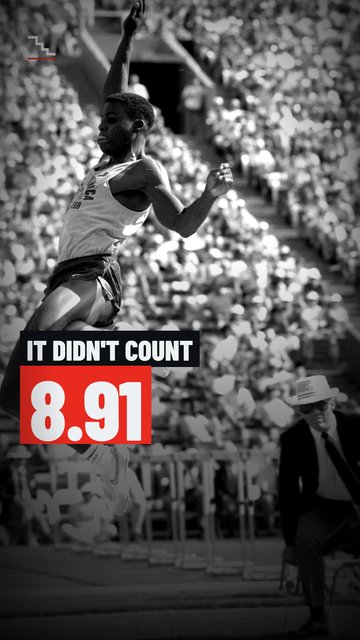
World Championships, Tokyo, 30 August 1991. In the fourth round, Lewis jumps 8.91. Further than Beamon, but the wind reads plus 2.9.
Too much, it doesn't count. One round later, the wind drops to plus 0.3, and Mike Powell jumps 8.95, five centimetres. After 23 years, that's all it took.
Beamon's record finally fell, and it fell at sea level in a fair wind.
6:04The edge now
Powell's 8.95 is still the world record. It has now stood for 35 years, longer than Beamon's ever did. Every few years, someone comes close.
Iván Pedroso once jumped 8.96 high in the Alps, but a person was standing in front of the wind gauge and it was never ratified. Every record has an edge. Beamon didn't move it a few centimetres.
He threw it so far down the pit that the sport needed a generation to catch up.