0:00The legend
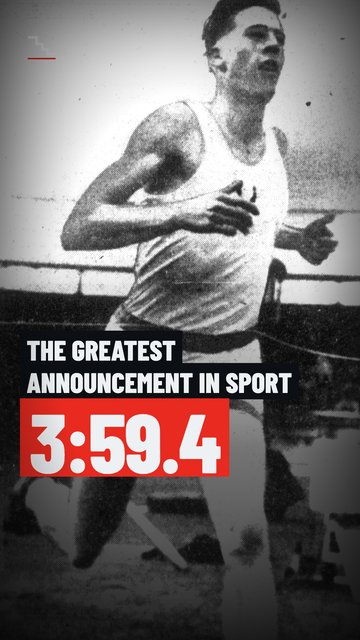
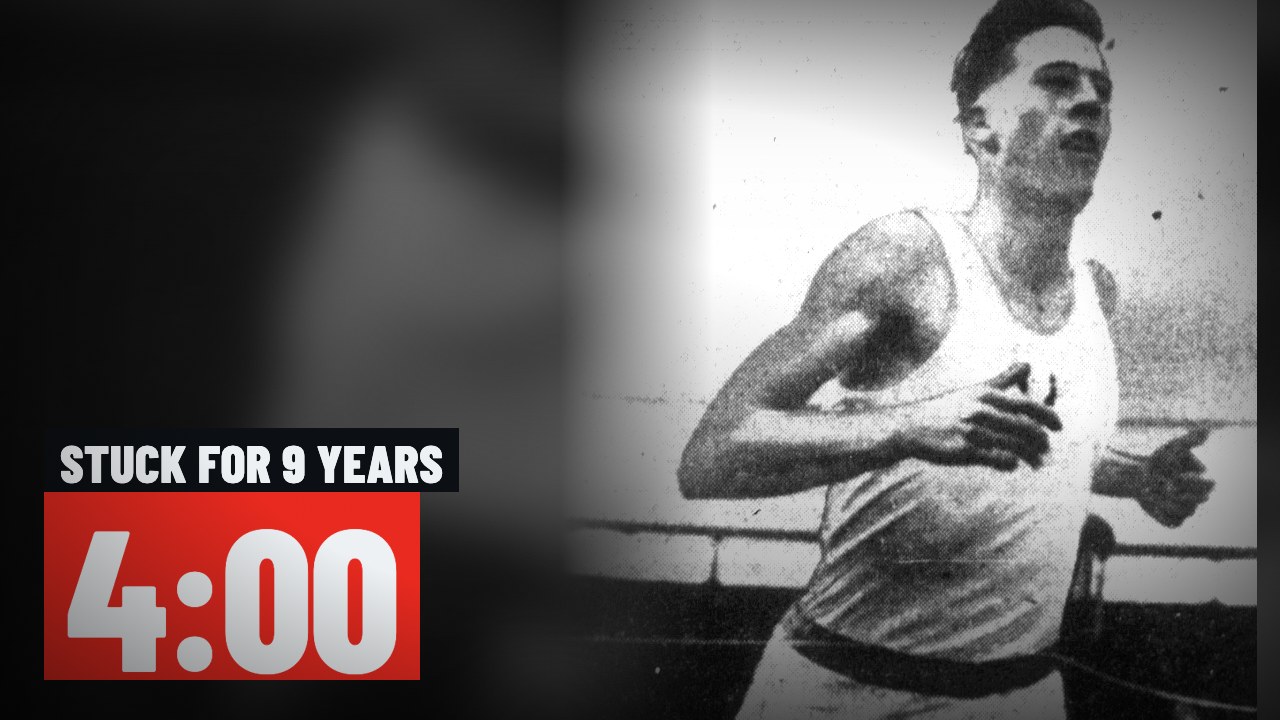
For nine years, nobody on Earth could run a mile faster than four minutes and one second. Then, on a cold, windy Thursday in Oxford, a 25-year-old medical student ran it in three minutes, 59.4 seconds. 46 days later, someone else did it too.
Today, more than 2,000 people have. So the story goes, the wall was never in the body. It was in the mind.
Once one man proved it possible, everyone believed, and the wall fell. It's one of the most repeated stories in sport, and it's mostly wrong.
0:39The doctors' warning
You've probably heard the version where doctors warned that a human heart would burst. That a runner who tried to break four minutes might die on the track. Bannister himself told that story later, half as a joke.
After he collapsed at the finish, he said he figured he was dead. But historians who went looking for those doctors found something awkward. There's very little evidence they ever existed.
There was no medical consensus that four minutes was impossible. The four minute mile wasn't a scientific limit. It was a round number that newspapers loved.
To see what actually held it back, you have to look at the data.
1:17The record line, 1913–1945
This is the men's mile world record since 1913. Each step is a new record. For 30 years it falls steadily.
Paavo Nurmi, the Flying Finn, takes it to 4:10 in 1923. Then the record keeps sliding, a second here, a second there. In the 1940s, two Swedes go to war with each other on the track.
Gunder Hägg and Arne Andersson. While most of Europe is fighting a real war, neutral Sweden keeps racing. Between them, they take the record down to 4:01.4.
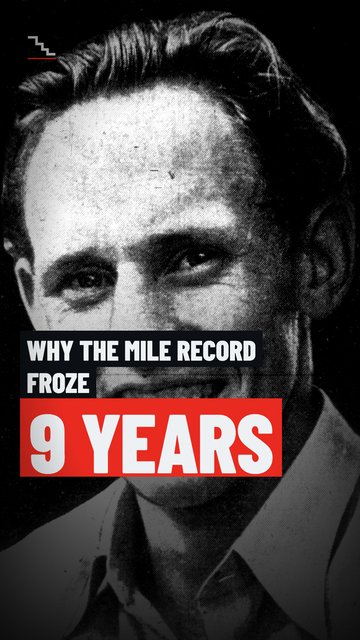
At that pace, four minutes should have gone within a year or two. Instead, the line goes flat. For nine years.
Why?
1:58Why the line went flat
In 1946, Swedish officials discovered that Hägg and Anderson had been paid for running. In the amateur era, that was the ultimate sin. Both were banned for life.
In one decision, the two fastest milers in the world were gone. The rest of the world was rebuilding from war. Athletes trained part-time around jobs and studies.
Bannister was a full-time medical student. He trained once a day for about 30 minutes, around 28 miles a week, when many of his rivals ran more than 60. So the wall wasn't in anyone's heart or lungs.
It was in the sport itself. War, amateur rules, and nobody fast enough left to chase the record.
2:41The man who didn't win
Roger Bannister wasn't supposed to be the man. At the 1952 Helsinki Olympics, he was a favourite in the 1,500 metres. He finished fourth, no medal.
He considered quitting. Instead, he set himself a new target. Become the first man under four minutes before anyone else got there.
Because someone else was close. In Australia, John Landy had run 4:02. Then he did it again.
And again. Six times. a frustrated Landy told a newspaper, "Frankly, I think the four-minute mile is beyond my capabilities. Two seconds may not sound much, but to me it's like trying to break through a brick wall."
Remember that quote, we'll come back to it.
3:266 May 1954, Iffley Road
If you like stories about where human limits really are, subscribe, that's all this channel does. Thursday 6th May, 1954. Bannister works a morning at the hospital in London, then takes the train to Oxford.
The weather is terrible. Running into that wind, a record is pointless. He decides not to run.
Minutes before the start, the wind drops. He decides to go. The plan is simple.
His two friends will act as pacemakers. Chris Brasher takes the first two laps. Chris Chataway takes the third.
Bannister does the last lap alone. Lap 1: 57.5 seconds. Lap 2: 60.7, halfway in 1:58.2.
On pace, lap 3: 62.3. Too slow. At the bell, he's just past three minutes.
To break four he needs a last lap of about 59 seconds. With about 250 yards to go, he passes Chataway and runs alone. Last lap: 58.9.
4:31"The time was three…"
The announcer is Norris McWhirter, who would later co-found the Guinness Book of Records. He draws it out on purpose. "A new meeting and track record, and which, subject to ratification, will be a new English Native, British National, All- Comers, European, British Empire and World Record."
The time was three… Nobody hears the rest. The crowd is already on the track.
3:59.4
5:00Landy, 46 days later
Now back to John Landy, the man who called four minutes a brick wall. Forty-six days after Oxford in Turku, Finland, Landy runs 3:58. Not just under four minutes, faster than Bannister, nearly four seconds faster than the 4:02 he'd been stuck on for months.
So was it in the head after all? Partly maybe, Landy was racing in better conditions in Finland with real competition. But it's hard to look at those six identical 4:02s and say belief had nothing to do with it.
The honest answer is both. The sport built the wall, belief helped knock it down.
5:36Vancouver: the Miracle Mile
Then they met. August the 7th, 1954, the British Empire Games in Vancouver. The only two men in history to have broken four minutes, in the same race, 35,000 people in the stadium, millions more watching on television.
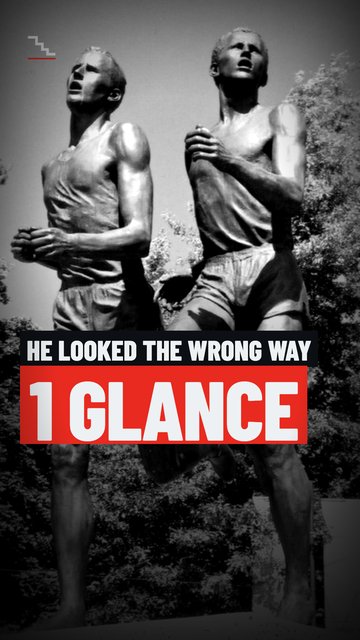
Landy leads from the start. Coming into the final bend, he glances over his left shoulder to see where Bannister is. At that exact moment, Bannister goes past him on the right.
Bannister wins in 3:58.8. Landy 3:59.6. Two men under four minutes in one race, three months after it was "impossible".
Today there's a statue outside the old stadium site of that exact moment. One man looking back, the other going past.
6:21The edge moves: Kerr and Kipyegon
By now, over 2,000 people have run a sub -4 minute mile. High school kids do it. In 2025 alone, 70 American men ran their first.
The line kept falling. Then in 1999 in Rome, Hicham El Guerrouj ran 3:43.13. And the line went flat again.
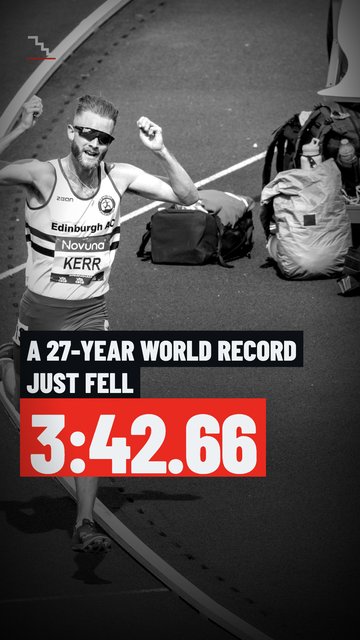
For 27 years. Until this summer. July 18, 2026.
London. Josh Kerr, a Scot, with 60,000 people in the stadium. His team called it Project 222.
3 minutes, 42 seconds. Another round number. He ran 3:42.66.
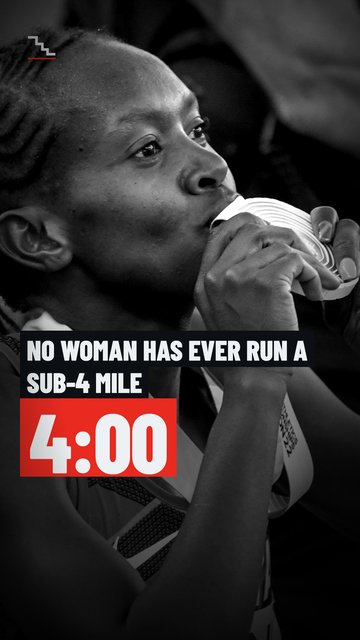
72 years after Oxford, a British runner took the mile record again. And there's one barrier still standing. No woman has ever run a mile under four minutes.
In June 2025, Faith Kipyegon tried with pacemakers and custom shoes in Paris. She ran 4:06.42. Faster than any woman in history and still more than six seconds short.
Four minutes again. A round number. A thin edge.
7:33Every record has a wall
The four-minute mile wasn't a law of nature. It was a number that waited nine years for the right conditions and the right person. When it fell, it fell all at once.
Every record has a wall like that somewhere. This channel is about the people who find it.